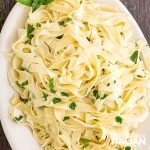
Fresh Homemade Pasta Dough Recipe (How to Make)
This homemade pasta dough recipe is easy to follow and uses 5 simple ingredients. Make fresh pasta from scratch right in your own kitchen!
Ingredients
- 1 1/2 cups all purpose flour
- 1/2 cup cake flour
- 3 large eggs
- 1 1/2 teaspoons extra-virgin olive oil
- 1/2 teaspoon sea salt
- Semolina and/or rice flour for dusting
Instructions
- Mound all-purpose and cake flours on clean countertop or cutting board.
- Add 1 1/2 teaspoons of olive oil and three eggs to a well in the center of the flour.
- Use a fork to whisk the eggs, drawing in the flour as you whisk until as much of the flour is incorporated as possible. Use your hands to continue mixing the dough when most of the flour is incorporated.
- Knead the dough for 10 minutes, noticing that the shaggy dough gradually becomes more soft and pliable.
- Form a ball with the dough and place in a plastic bag or wrap with plastic wrap. Set aside to rest for 30 minutes.
- Bring a large pot of salted water to a boil.
- Divide the rested pasta dough into 2-4 sections. Work with one section at a time, keeping the remaining sections wrapped.
- Use a rolling pin or a pasta machine to roll out a long rectangle of dough. Roll it as thin as possible if working by hand. With a pasta machine, roll the dough on gradually smaller settings until you can roll it out on the second to thinnest or thinnest setting (experiment with various thicknesses for desired preference. Shape the dough into as close to a rectangle shape as possible by folding in tapering sides and re-rolling as needed.
- Now, cut the pasta dough into thin strips with a pizza cutter (for a fettucine). You can also run the dough through the fettuccine, spaghetti, etc. attachment on your pasta machine.
- Regardless of cutting method, sprinkle surfaces and pasta machine with semolina flour to keep it from sticking to the surfaces.
- If folding the dough over on itself for bulk cutting OR if storing the cut pasta in a pile or layered, it is most helpful to sprinkle generously with rice flour to prevent the pasta from sticking to itself.
- Cook fresh pasta for 2-3 minutes in a pot of salted, boiling water until the pasta is cooked through - it will lighten slightly in color and expand a bit.
- Or, hang the pasta in separate pieces on a pasta drying rack. Alternately, spread pasta out on a cookie sheet to dry. Pasta takes 1-2 days to dry and can then be stored in an airtight container.
Notes
There are lots of different types of flour that can be used for pasta dough. All-purpose flour works perfectly well. 00 flour is great if available for a more silky pasta. Semolina flour will make a chewier pasta. We used some cake flour mixed with the all-purpose flour here for an approximation of a softer “00” type flour. Cake flour does not have the same protein content that 00 flour does, though, so cannot be substituted in full. You can also use 100% all-purpose flour, 100% 00 flour, or some combination with semolina.
Rolling the pasta dough is quite a bit easier to get nice and thin if you use a pasta machine.
Rice flour does not have gluten in it so it will not bond with the glutens in the pasta dough - it’s a really great dusting flour, especially if you want to make those lovely little piles of swirled noodles. They will separate more easily when you throw them into the boiling water if they have been generously dusted all throughout with rice flour.
If you are cutting pasta by hand and want to make long fettuccine-type noodles, sprinkle the rolled surface liberally with rice flour; then fold it over on itself to cut more pasta in each slice.
Store in an airtight container for up to 3 days or freeze for up to 3 months.
Nutrition
Serving: 1 | Calories: 287cal | Carbohydrates: 47g | Protein: 11g | Fat: 5g | Saturated Fat: 1g | Cholesterol: 123mg | Sodium: 339mg | Sugar: 1g | Fiber: 2g | Calcium: 28mg | Iron: 3mg